Peer Perspectives
Real-world experiences with IZERVAY, shared by your peers
Hear from leading retina specialists on why GA treatment requires a different mindset
Dr. Khanani: Counting every moment in GA treatment

Dr. Arshad Khanani explains why potentially preserving vision for longer is a meaningful treatment goal for patients with GA.1,2
Hi, my name is Dr. Arshad Khanani, and I’m a Director of Clinical Research and Director of Fellowship at Sierra Eye Associates, and Clinical Professor at the University of Nevada, Reno School of Medicine. And through it all, I’m a protector of my patients’ vision. When we treat patients with geographic atrophy (GA), we must ask ourselves a very simple, yet critical question—what are the options? Either we just give up and let patients continue towards blindness—or we do everything we can to slow down the progression of their disease and potentially preserve vision for longer.
For me, potential preservation of vision for longer is the primary goal of GA treatment, which can provide a functional benefit for patients. I compare GA treatment to the wet AMD market before anti-VEGFs. We wanted anything to slow down the disease and preserve vision for longer, and I think we are in that era right now with GA. We must use the treatment options that are available now, rather than waiting. I like to use this analogy—if there’s a fire in your house, but it’s only in the garage, you may still be able to protect the house. This same idea applies to GA treatment. While some retinal cells may already be lost, it’s critical to protect the remaining healthy retinal cells for longer.
To me, there are expectational differences between treating wet AMD and GA. We are used to seeing “wow” effects for patients with wet AMD, where the fluid goes away and we can claim a clear victory for the patient. The patient is happy and we are happy. With GA, I tell my patients the treatment goal is different. It’s not restoration we are after, but the potential of more time with their remaining vision. This is a paradigm shift from what we are used to doing. There’s no way to reverse the disease, so we need to focus on preserving their vision for longer.
I not only believe that every patient deserves treatment, but I believe they should have a say in deciding if they want it or not. It’s our job as professionals to offer treatment and discuss the risks and benefits with them. And in my experience, the only patients that don’t seem to want treatment are those that don’t understand it. The majority of GA patients appreciate being informed and empowered—and the majority of patients want treatment. That’s why our role as retina specialists is so important. Over the last decades, we have done numerous clinical trials where patients are so desperate to have any treatment that they participated in sham-controlled studies. So, anything to slow down the worsening of disease and preserve vision for longer is a big, big thing for these patients. If we as retina specialists do not take the time to properly educate our patients about their disease and the impact of treatment, patients may lose more time with their remaining vision. The sooner we start the treatment, the sooner we may start slowing down the progression of their GA. Essentially, we are potentially buying our patients more time with their remaining vision. Any additional time they can have with their vision means so much to them. That’s an important partnership for us to have, as patients and retina specialists.
INDICATION
IZERVAY™ (avacincaptad pegol intravitreal solution) is indicated for the treatment of geographic atrophy (GA) secondary to age-related macular degeneration (AMD)
IMPORTANT SAFETY INFORMATION
CONTRAINDICATIONS
IZERVAY is contraindicated in patients with ocular or periocular infections and in patients with active intraocular inflammation.
WARNINGS AND PRECAUTIONS
Endophthalmitis and Retinal Detachments
- Intravitreal injections, including those with IZERVAY, may be associated with endophthalmitis and retinal detachments. Proper aseptic injection technique must always be used when administering IZERVAY in order to minimize the risk of endophthalmitis. Patients should be instructed to report any symptoms suggestive of endophthalmitis or retinal detachment without delay and should be managed appropriately.
Neovascular AMD
- In clinical trials, use of IZERVAY was associated with increased rates of neovascular (wet) AMD or choroidal neovascularization (7% when administered monthly and 4% in the sham group) by Month 12. Over 24 months, the rate of neovascular (wet) AMD or choroidal neovascularization in the GATHER2 trial was 12% in the IZERVAY group and 9% in the sham group. Patients receiving IZERVAY should be monitored for signs of neovascular AMD.
Increase in Intraocular Pressure
- Transient increases in intraocular pressure (IOP) may occur after any intravitreal injection, including with IZERVAY. Perfusion of the optic nerve head should be monitored following the injection and managed appropriately.
ADVERSE REACTIONS
Most common adverse reactions (incidence ≥5%) reported in patients receiving IZERVAY were conjunctival hemorrhage, increased IOP, blurred vision, and neovascular age-related macular degeneration.
Please see full Prescribing Information on IZERVAYecp.com.
Dr. Chin Yee: Redefining success in GA treatment starts with protection

Dr. David Chin Yee breaks down why GA management requires a different mindset and how taking action with IZERVAY today to protect healthy retinal cells may help patients preserve their vision for longer.1,2
Hello. My name is Dr. David Chin Yee and I’m a retina specialist at Georgia Retina. And through it all, I’m a protector of my patients’ vision. I’ve always seen myself as a protector, especially for my patients with geographic atrophy. I grew up in Jamaica and when I was younger, I used to volunteer at a home for the blind. In that work—in seeing the impact vision loss had on the lives of those who are visually impaired—it made me want to do everything I could to help patients preserve their vision for longer.
We know that geographic atrophy is a devastating disease that, unfortunately, we don’t have a way to stop. But we do have tools that can help slow down the progression of GA by protecting healthy retina cells for longer. As retina specialists, why wouldn’t we want to use those tools? With GA treatment like IZERVAY, we’re providing a kind of guardrail to help patients potentially preserve their vision for longer.
I think it’s critical to start IZERVAY as soon as possible. To me, GA is like glaucoma. You don’t wait until the cup is .9. You start when it’s .5 to keep patients from falling off that cliff. I talk to my patients about the efficacy and safety data for IZERVAY. I make sure that they have no infection or active swelling in or around their eye. I also discuss the risks associated with an eye injection such as an infection or retinal detachment. I reassure them that IZERVAY has no warning for intraocular inflammation or retinal vasculitis, and that it has a low incidence of CNV. We can’t sit back and watch. I believe in the data, and I know that my patients want to preserve their vision for longer and maintain their current sight for as long as possible. So why not start treatment as soon as we identify the disease?
Proactively protecting healthy retinal cells for longer is essential. And I have found that patients appreciate this early management. They love feeling more involved and active in the treatment plan. It resonates with them if you are doing everything you can to make a difference.
Right now, working toward protecting healthy retinal cells for longer as soon as possible is our best option. The way I see it, my job is to provide my patients with the best potential visual outcome. Preserving and keeping the vision they have for a longer period of time is a win. When we slow GA progression and protect healthy retinal cells, what we are really doing is buying patients more time with their vision. When presented with available options, many of my patients think treatment is worth it—and so do I.
INDICATION
IZERVAY™ (avacincaptad pegol intravitreal solution) is indicated for the treatment of geographic atrophy (GA) secondary to age-related macular degeneration (AMD)
IMPORTANT SAFETY INFORMATION
CONTRAINDICATIONS
IZERVAY is contraindicated in patients with ocular or periocular infections and in patients with active intraocular inflammation.
WARNINGS AND PRECAUTIONS
Endophthalmitis and Retinal Detachments
- Intravitreal injections, including those with IZERVAY, may be associated with endophthalmitis and retinal detachments. Proper aseptic injection technique must always be used when administering IZERVAY in order to minimize the risk of endophthalmitis. Patients should be instructed to report any symptoms suggestive of endophthalmitis or retinal detachment without delay and should be managed appropriately.
Neovascular AMD
- In clinical trials, use of IZERVAY was associated with increased rates of neovascular (wet) AMD or choroidal neovascularization (7% when administered monthly and 4% in the sham group) by Month 12. Over 24 months, the rate of neovascular (wet) AMD or choroidal neovascularization in the GATHER2 trial was 12% in the IZERVAY group and 9% in the sham group. Patients receiving IZERVAY should be monitored for signs of neovascular AMD.
Increase in Intraocular Pressure
- Transient increases in intraocular pressure (IOP) may occur after any intravitreal injection, including with IZERVAY. Perfusion of the optic nerve head should be monitored following the injection and managed appropriately.
ADVERSE REACTIONS
Most common adverse reactions (incidence ≥5%) reported in patients receiving IZERVAY were conjunctival hemorrhage, increased IOP, blurred vision, and neovascular age-related macular degeneration.
Please see full Prescribing Information on IZERVAYecp.com.
Dr. Khanani: The GATHER trials explained
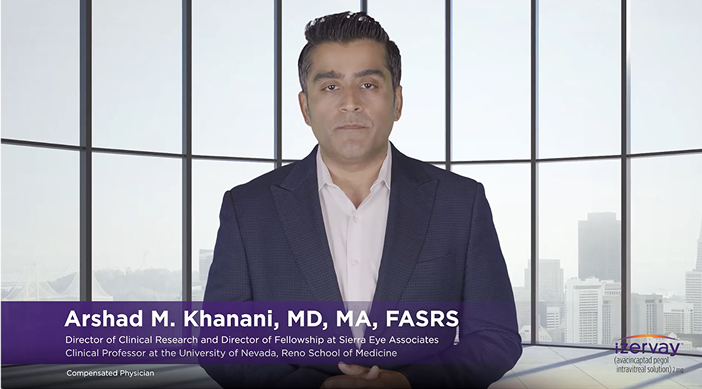
Dr. Arshad Khanani walks us through the key findings from the GATHER1 and GATHER2 trials, highlighting IZERVAY’s statistically significant impact on slowing GA progression. He explains how the treatment effect not only begins as early as 6 months but also continues to grow over time, more than doubling by 24 months.2,5
Geographic atrophy, or GA, can progress quickly and unpredictably, and your patients are at risk of losing vision each day.1 Taking action to potentially buy more time with their remaining vision matters to your patients.
In a survey of people with self-reported GA, 84% said they would try a treatment to slow GA and preserve their vision for longer, but only 14% receive treatment.2,3 Preserving your patients' vision is more than just their sight, it's about potentially protecting how your patients' may visually experience life for longer.
Hi, I’m Arshad Khanani, Director of Clinical Research and Director of Fellowship at Sierra Eye Associates, and Clinical Professor at the University of Nevada, Reno School of Medicine. Today I want to talk to you about IZERVAY™ (avacincaptad pegol intravitreal solution): a tool that we can use to protect patients’ healthy retinal cells for longer by slowing down the progression of GA.
IZERVAY is indicated for the treatment of geographic atrophy secondary to age-related macular degeneration, or AMD.4 IZERVAY is contraindicated in patients with ocular or periocular infections and in patients with active intraocular inflammation.4 Please see additional safety information at the end of the video.
IZERVAY was studied in patients with GA due to AMD in two randomized, multicenter Phase 3 trials: GATHER1, over 18 months, and GATHER2, over 24 months, with 624 patients across both trials.4-7 Both GATHER1 and GATHER2 were designed to evaluate the efficacy and safety of IZERVAY compared to sham with a primary endpoint at 12 months and additional long-term analyses conducted at 18 and 24 months.4
At the 12-month time point, IZERVAY achieved its primary clinical endpoints in both the GATHER1 and GATHER2 trials, demonstrating stat significant protection of healthy retinal cells within the first year of treatment with a 35% and 18% reduction in the annualized rate of GA growth in the GATHER trials.4 It is important to note that IZERVAY is the only GA treatment to demonstrate stat significant efficacy at one year in two Phase 3 trials.8 In addition to this early efficacy within the first year, IZERVAY started protecting healthy retinal cells as soon as 6 months. As you see through this 12-month timeframe, IZERVAY’s effect continued to grow in its separation from sham. This trend continued through 24 months.4 Let’s go there next.
When we look at the 24-month clinical data from GATHER2, IZERVAY demonstrated a 14% reduction in the annualized rate of GA growth with an increasing and doubling effect from baseline to 24 months compared to baseline to 12 months. At first glance, you may ask yourself how there could be a doubling effect when the results from GATHER2 year 1 showed an 18% annualized reduction in growth rate and GATHER2 across 24 months showed a 14% annualized reduction.4,9 Let’s take a closer look.
In GATHER2, patients receiving monthly IZERVAY were re-randomized at Month 12 to either continue monthly dosing or transition to every-other-month dosing.4 This re-randomization created two distinct treatment subgroups within the active arm for the second year of the study. As a result, new slopes for each subgroup needed to be recalculated from baseline to 24 months. Because this calculation separates the data into two distinct dosing regimens, monthly or every-other-month, we need to look at each treatment group in comparison to itself. In conclusion, the addition of different subgroups make it difficult to compare Year 1 and Year 2 data, which is why an annualized rate was calculated.4
Additionally, when we look at the piecewise analysis, which helps us understand how the treatment effect varies across 6-month time periods, we observe that the treatment effect more than doubled over the full 24 months as compared to the first 12 months.9 What makes the 24-month data meaningful is that it demonstrated a cumulative and increasing treatment effect over time. We see in the data that the separation between IZERVAY treatment groups versus sham continued to widen beyond Month 12, indicating that the treatment effect not only persisted, it increased over time.5
Now let's take a look at IZERVAY’s safety profile as demonstrated in the GATHER trials. IZERVAY is the only FDA-approved GA treatment with no warning or precaution for intraocular inflammation or retinal vasculitis.4,10 In the GATHER1 and GATHER2 trials, at 12 months, we saw a slight increase in neovascular wet AMD or choroidal neovascularization in patients treated with IZERVAY compared to the sham group. The rate was 7% in the IZERVAY treated group versus 4% in the sham group. In GATHER2, over 24 months, the rate of neovascular wet AMD or choroidal neovascularization was 12% with IZERVAY and 9% with sham.4,9 Safety findings through 24 months in patients with GA secondary to AMD were consistent with those observed at 12 months.5,6,9
We know that patients with GA will progress over time, but with IZERVAY, we have the potential to help our patients preserve their vision for longer.1 IZERVAY is the only GA treatment to demonstrate stat significant efficacy at one year in two Phase 3 trials.4,8 It also starts working early with efficacy demonstrated within the first year, and has continued to show an increasing treatment effect over time.4,9
As a physician, I’m looking at the totality of the data, and that’s why IZERVAY is my choice for my patients with GA. It’s time to close that gap between the 84% of patients with GA who desire treatment and the 14% who actually receive it.
INDICATION
IZERVAY™ (avacincaptad pegol intravitreal solution) is indicated for the treatment of geographic atrophy (GA) secondary to age-related macular degeneration (AMD)
IMPORTANT SAFETY INFORMATION
CONTRAINDICATIONS
IZERVAY is contraindicated in patients with ocular or periocular infections and in patients with active intraocular inflammation.
WARNINGS AND PRECAUTIONS
Endophthalmitis and Retinal Detachments
- Intravitreal injections, including those with IZERVAY, may be associated with endophthalmitis and retinal detachments. Proper aseptic injection technique must always be used when administering IZERVAY in order to minimize the risk of endophthalmitis. Patients should be instructed to report any symptoms suggestive of endophthalmitis or retinal detachment without delay and should be managed appropriately.
Neovascular AMD
- In clinical trials, use of IZERVAY was associated with increased rates of neovascular (wet) AMD or choroidal neovascularization (7% when administered monthly and 4% in the sham group) by Month 12. Over 24 months, the rate of neovascular (wet) AMD or choroidal neovascularization in the GATHER2 trial was 12% in the IZERVAY group and 9% in the sham group. Patients receiving IZERVAY should be monitored for signs of neovascular AMD.
Increase in Intraocular Pressure
- Transient increases in intraocular pressure (IOP) may occur after any intravitreal injection, including with IZERVAY. Perfusion of the optic nerve head should be monitored following the injection and managed appropriately.
ADVERSE REACTIONS
Most common adverse reactions (incidence ≥5%) reported in patients receiving IZERVAY were conjunctival hemorrhage, increased IOP, blurred vision, and neovascular age-related macular degeneration.
Please see full Prescribing Information on IZERVAYecp.com.
References
1. Fleckenstein M, Mitchell P, Freund KB, et al. The progression of geographic atrophy secondary to age-related macular degeneration. Ophthalmology. 2018;125(3):369-390. 2. Bakri SJ, Brinkmann CK, Mulvey A, et al. Characterizing patient perceptions of living with geographic atrophy: the global Geographic Atrophy Insights Survey. Clin Ophthalmol. 2024;18:3725-3737. 3. Astellas Pharma US, Inc. Izervay. Data on File. 4. Izervay. Package insert. Northbrook, IL: Astellas Pharma US, Inc.; 2025. 5. Patel SS, Lally DR, Hsu J, et al. Avacincaptad pegol for geographic atrophy secondary to age-related macular degeneration: 18-month findings from the GATHER1 trial. Eye (Lond). 2023;37(17):3551-3557. 6. Khanani AM, Patel SS, Staurenghi G, et al. Efficacy and safety of avacincaptad pegol in patients with geographic atrophy (GATHER2): 12-month results from a randomised, double-masked, phase 3 trial. Lancet. 2023;402(10411):1449-1458. 7. Clinical Trials.gov. Zimura in Participants With Geographic Atrophy Secondary to Age-Related Macular Degeneration. Accessed August 14, 2025. https://clinicaltrials.gov/study/NCT02686658 8. Heier JS, Lad EM, Holz FG, et al. Pegcetacoplan for the treatment of geographic atrophy secondary to age-related macular degeneration (OAKS and DERBY): two multicentre, randomized, double-masked, sham-controlled, phase 3 trials. Lancet. 2023;402(10411):1434-1448. 9. Astellas Pharma US, Inc. Izervay. Data on File. 10. Syfovre. Package Insert. Waltham, MA: Apellis Pharmaceuticals. 2025.
Dr. Kim: Talking to patients about GA and IZERVAY

Dr. Esther Kim shares how open conversations can help GA patients better understand their condition, feel empowered in their choice of treatment, and make informed choices that may preserve their vision for longer.1,2
Hi. I’m Dr. Esther Kim. I’m a vitreoretinal surgeon at Orange County Retina in California. And through it all, I’m a protector of my patients’ vision.
Right now, in GA, there isn’t the same urgency to intervene as we see with wet AMD. Instead of days or weeks, the treatment conversations can take months. In those months, patients could be losing precious vision. It’s important for the care team, including patients, to prioritize GA and initiate treatment sooner.
When we make the decision to try and preserve vision for longer, patients will naturally have questions and they should. They ask questions like “how will it feel?” and “is it safe?” It’s important for them to understand the consequences of GA and all their options for management and treatment. Having pragmatic, compassionate conversations with my patients helps them feel empowered to be part of their treatment decisions.
I talk to my patients about the efficacy and safety data for IZERVAY. Then I explain that there is treatment that may help preserve their vision for longer. I make sure that they have no infection or active swelling in or around their eye. I also discuss the risks associated with an eye injection such as an infection or retinal detachment. I reassure them that IZERVAY has no warning for intraocular inflammation or retinal vasculitis and that it has a low incidence of CNV. Many want to know more about the administration. I find when I use plain language, the patients are very understanding.
Accessibility is important to my patients. IZERVAY has an effective patient support program that many of my patients have found helpful. Prioritizing safety and accessibility, along with having robust conversations with my patients, gives me an extra level of confidence when treating with IZERVAY.
INDICATION
IZERVAY™ (avacincaptad pegol intravitreal solution) is indicated for the treatment of geographic atrophy (GA) secondary to age-related macular degeneration (AMD)
IMPORTANT SAFETY INFORMATION
CONTRAINDICATIONS
IZERVAY is contraindicated in patients with ocular or periocular infections and in patients with active intraocular inflammation.
WARNINGS AND PRECAUTIONS
Endophthalmitis and Retinal Detachments
- Intravitreal injections, including those with IZERVAY, may be associated with endophthalmitis and retinal detachments. Proper aseptic injection technique must always be used when administering IZERVAY in order to minimize the risk of endophthalmitis. Patients should be instructed to report any symptoms suggestive of endophthalmitis or retinal detachment without delay and should be managed appropriately.
Neovascular AMD
- In clinical trials, use of IZERVAY was associated with increased rates of neovascular (wet) AMD or choroidal neovascularization (7% when administered monthly and 4% in the sham group) by Month 12. Over 24 months, the rate of neovascular (wet) AMD or choroidal neovascularization in the GATHER2 trial was 12% in the IZERVAY group and 9% in the sham group. Patients receiving IZERVAY should be monitored for signs of neovascular AMD.
Increase in Intraocular Pressure
- Transient increases in intraocular pressure (IOP) may occur after any intravitreal injection, including with IZERVAY. Perfusion of the optic nerve head should be monitored following the injection and managed appropriately.
ADVERSE REACTIONS
Most common adverse reactions (incidence ≥5%) reported in patients receiving IZERVAY were conjunctival hemorrhage, increased IOP, blurred vision, and neovascular age-related macular degeneration.
Please see full Prescribing Information on IZERVAYecp.com.
GA=geographic atrophy.