
IZERVAY 3.5-year GATHER2 open-label extension (OLE) trial: Safety and treatment observations

Image of Dr. Arshad Khanani

These OLE analyses help us better understand IZERVAY’s role in GA management.”

Dr. Arshad M. Khanani, Vitreoretinal Surgeon

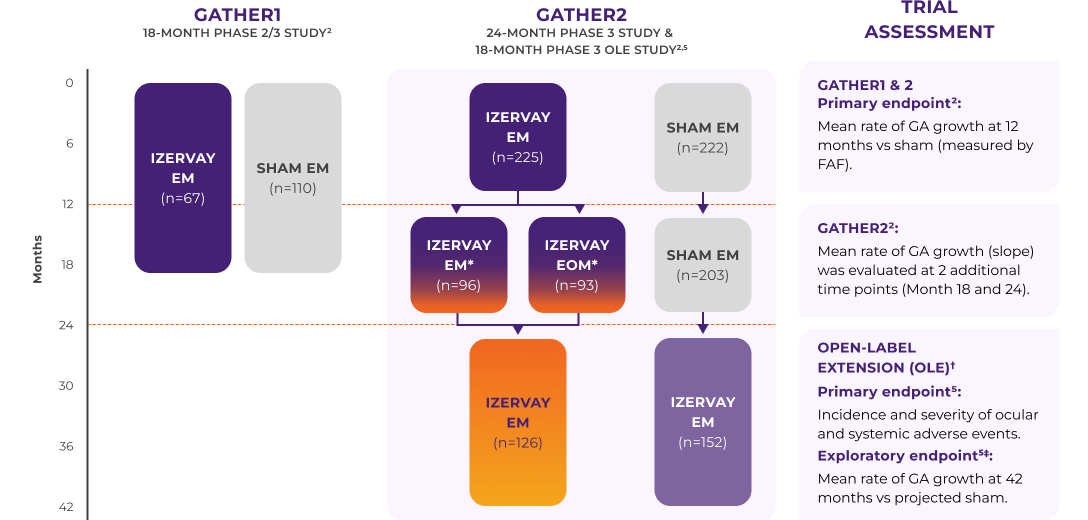
IZERVAY was assessed in two Phase 3 trials and an OLE study through 3.5 years2,5

Graph of efficacy data from GATHER Trial: 35% reduction in mean rate of GA growth at 12 months

EM=every month; EOM=every other month; FAF=fundus autofluorescence; IOP=intraocular pressure; LLD=low luminance deficit; LLVA=low luminance visual acuity; OE=ophthalmic examination.

*Patient re-randomization.

All participants, regardless of prior GATHER2 treatment (IZERVAY or sham), received IZERVAY in the study eye. All participants were to have a final follow-up visit or follow-up procedure at Month 42 if the study was terminated early. The end of the study was defined as the date of the last study assessment for the last participant in the study globally.

Exploratory endpoints include the following ophthalmic variables: BCVA, LLVA, LLD, IOP, OE, and GA area.

The recommended dose for IZERVAY is 2 mg once monthly (approximately 28 +/- 7 days)2

Primary endpoint data

IZERVAY provided significant protection of healthy retinal cells in just one year of treatment2

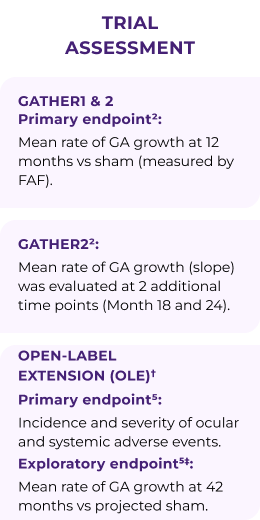
The primary endpoint in GATHER1 and 2 evaluated the mean rate of GA growth (slope) from baseline to Month 12, measured by FAF at 3 time points (baseline, Month 6, and Month 12). In GATHER2, the mean rate of GA growth (slope) measured by FAF was evaluated at 2 additional time points (Month 18 and Month 24).2

Reductions in mean rate of growth (MMRM analysis) at 12 months vs sham2
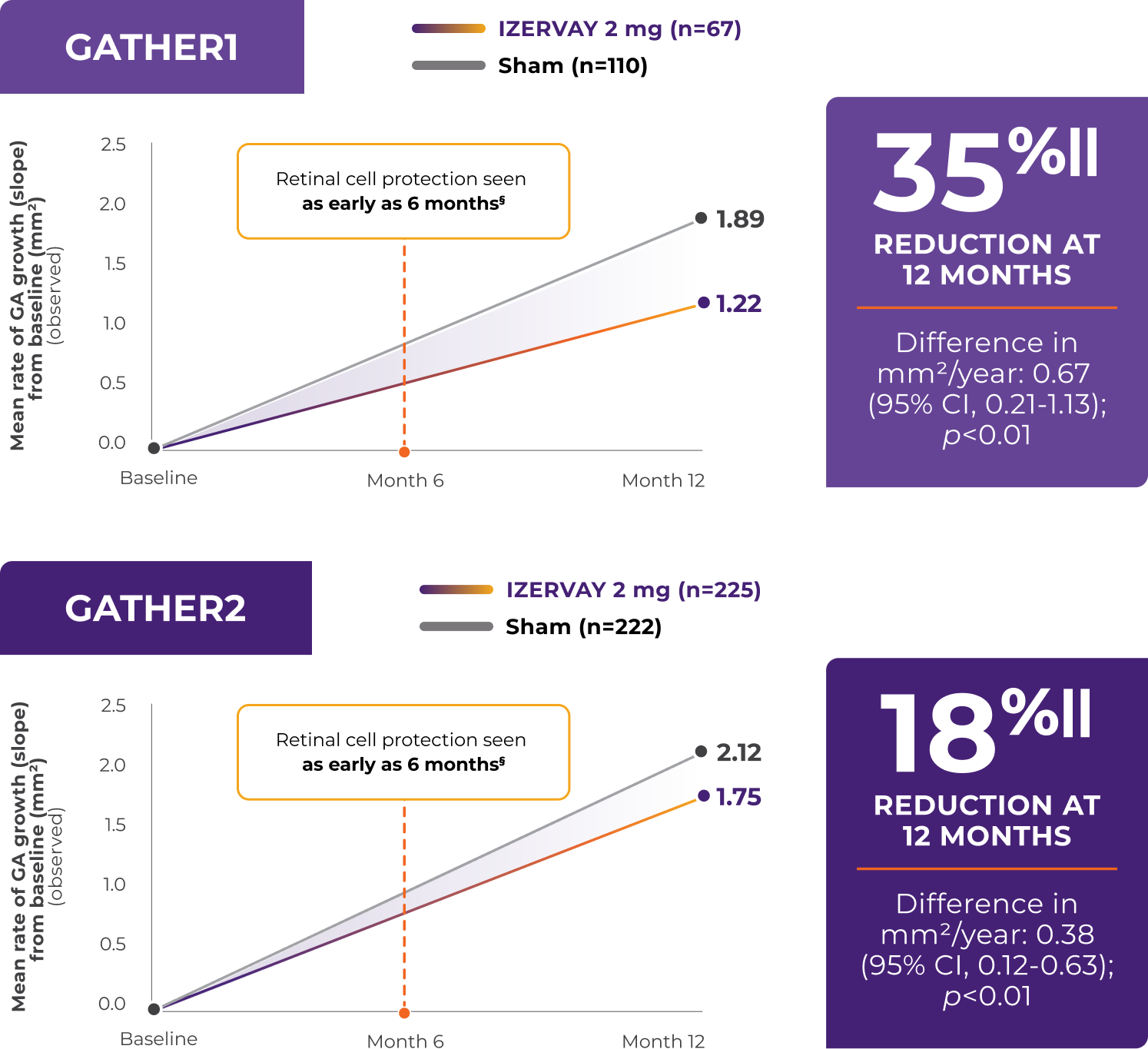
Graph of efficacy data from GATHER1 Study: 35% reduction in mean rate of GA growth at 12 months

IZERVAY is the only GA treatment to demonstrate statistically significant efficacy at one year in two Phase 3 trials2,4

CI=confidence interval; MMRM=mixed models for repeated measures.

§6-month time point was not part of the primary analysis, is observational in nature and should be interpreted with caution, and cannot be considered conclusive.

||Percent difference is calculated by 100×(difference)/(least squares mean from sham).
24-Month data

IZERVAY demonstrated an increasing treatment effect over 2 years2,8

Analysis of mean growth in GA area (mm2) at Month 24 vs sham5,8¶

Piecewise spline multivariate slope.

The annualized rate of GA growth (MMRM analysis)# at 24 months in GATHER22

IZERVAY 2 mg EM

  • 2.23 mm2/year
  • 14% reduction at 24 months; difference vs sham (95% Cl) mm2/year=0.36 (0.07-0.66); p=0.0165**

IZERVAY 2 mg EM to EOM

  • 2.10 mm2/year
  • Due to the hierarchical testing procedure, no statistical test was performed for the EOM treatment group

The recommended dose for IZERVAY is 2 mg once monthly (approximately 28 ± 7 days)2

Analysis is based on MMRM assuming a piecewise linear trend at Month 6, 12, 18, including effects for treatment, time, and time by treatment interaction.

#Non-transformed GA growth slope analysis.

**Percent difference is calculated by 100×(difference)/(least squares mean from sham).
Safety

Proven safety through 2 years in the GATHER trials2

IZERVAY is the only FDA-approved GA treatment with no warning and precaution for intraocular inflammation or retinal vasculitis2,4

Common ocular adverse reactions (≥2%) and greater than sham in study eye2

GATHER1 & GATHER2

12 Months

GATHER2

24 Months

IZERVAY

(n=292)

Sham

(n=332)

IZERVAY

(n=225)

Sham

(n=222)

Conjunctival hemorrhage13%9%17%9%
Increased intraocular pressure (IOP)9%1%13%1%
Blurred vision††8%5%14%5%
Choroidal neovascularization (CNV)7%4%12%9%
Eye pain4%3%7%4%
Vitreous floaters2%<1%4%<1%
Blepharitis2%<1%3%<1%
Punctate keratitis‡‡10%8%
Retinal hemorrhage4%3%
Ocular hypertension4%0
Corneal abrasion2%<1%

Adverse reactions marked with a dash occurred at a rate of <2% or were not greater than sham at 12 months.

  • ≤1% of patients treated with IZERVAY for up to 24 months across the GATHER trials reported experiencing photopsia, ischemic optic neuropathy, vitreous hemorrhage, vitreal cells, vitritis, and endophthalmitis2§§

No cases of retinal vasculitis were reported in the GATHER trials5

The real-world safety profile across nearly 600k vials of IZERVAY remains consistent with findings from the GATHER trials2,5||||

††Blurred vision includes visual impairment, vision blurred, visual acuity reduced, visual acuity reduced transiently (and blindness transient for GATHER2 24 months).

‡‡Punctate keratitis includes punctate keratitis and keratitis.

§§Culture positive.

||||As of 02/26. Based on samples and commercially distributed vials.

OLE primary endpoint

No cases of retinal or occlusive vasculitis were reported through 3.5 years5

Ocular TEAEs ≥2% during open-label extension

IZERVAY to IZERVAY EM

(n=125)

Sham to
IZERVAY EM

(n=151)
Ocular TEAEs in the study eye, %59.2%58.3%
Increased intraocular pressure (IOP)15.2%13.2%
Cataract12.8%7.3%
Conjunctival hemorrhage10.4%9.9%
Vitreous detachment5.6%0.7%
Visual acuity reduced5.6%13.2%
New-onset CNV¶¶5.6%9.3%
Punctate keratitis3.2%6.0%
Transient visual lost3.2%2.0%
Posterior capsule opacification2.4%4.6%

IZERVAY treatment duration5:

  • IZERVAY to IZERVAY: 42 months
  • Sham to IZERVAY: 18 months

TEAE=treatment emergent adverse event.

¶¶New-onset CNV includes patients with CNV incidence during open-label extension portion but not CNV that occurred during the GATHER2 trial.

OLE exploratory endpoint

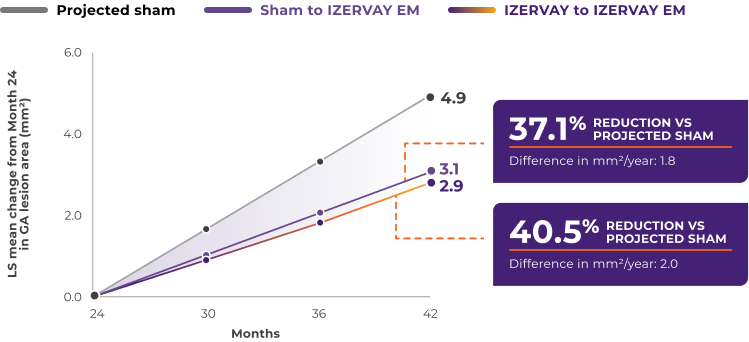
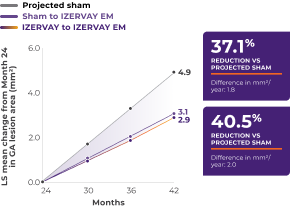
Observed reduction in rate of GA lesion growth vs projected sham by 37.1% and 40.5% from Months 24-425

Given the exploratory nature of the data, these results should be interpreted with caution and cannot be considered conclusive. The OLE analysis used a projected sham and may not reflect rate of change for all GA patients. Although prespecified, there was no statistical testing hierarchy. Open-label studies can allow for selection bias; clinical significance is not established.

Reductions in mean rate of growth (MMRM analysis) from Months 24 to 42 vs projected sham5

Graph of efficacy data from GATHER1 Study: 35% reduction in mean rate of GA growth at 12 months

Methodology: For projected sham, GA growth rate from Month 24 to Month 42 was first calculated as the average transformed growth rates across four 6-month intervals (baseline through Month 24) in the GATHER2 sham group and subsequently converted to the untransformed scale.5

For the IZERVAY groups, a separate piecewise MMRM was applied using square root transformed GA area data. The least squares mean of the square root transformed GA area was calculated and converted to the untransformed scale.5

LS=least squares.

Download the 3.5-year GATHER2 open-label extension brochure now 

Download brochure

See safety data

Next page

IMPORTANT SAFETY INFORMATION AND INDICATION

CONTRAINDICATIONS

IZERVAY® (avacincaptad pegol intravitreal solution) is contraindicated in patients with ocular or periocular infections and in patients with active intraocular inflammation.

WARNINGS AND PRECAUTIONS

Endophthalmitis and Retinal Detachments

  • Intravitreal injections may be associated with endophthalmitis and retinal detachments. Proper aseptic injection technique must always be used when administering IZERVAY in order to minimize the risk of endophthalmitis. Patients should be instructed to report any symptoms suggestive of endophthalmitis or retinal detachment without delay, to permit prompt and appropriate management.

Neovascular AMD

  • In the GATHER1 and GATHER2 clinical trials, use of IZERVAY was associated with increased rates of neovascular (wet) AMD or choroidal neovascularization (7% when administered monthly and 4% in the sham group) by Month 12. Over 24 months, the rate of neovascular (wet) AMD or choroidal neovascularization in the GATHER2 trial was 12% in the IZERVAY group and 9% in the sham group. Patients receiving IZERVAY should be monitored for signs of neovascular AMD.

Increase in Intraocular Pressure

  • Transient increases in intraocular pressure (IOP) have been observed after an intravitreal injection, including with IZERVAY. Perfusion of the optic nerve head should be monitored following the injection and managed as needed.

ADVERSE REACTIONS

Most common adverse reactions (incidence ≥5% and occurred with frequency ≥2% vs. sham) reported in patients receiving IZERVAY for up to 24 months in GATHER2: conjunctival hemorrhage, blurred vision, increased IOP, wet AMD, punctate keratitis, and eye pain.

INDICATION

IZERVAY is indicated for the treatment of geographic atrophy (GA) secondary to age-related macular degeneration (AMD).

Please see full Prescribing Information for more information.

To request medical information, please call 1-800-727-7003 or send an email to medinfo.americas@astellas.com. To report an adverse event or product complaint, please call 1-800-727-7003 or send an email to safety-us@astellas.com.

IMPORTANT SAFETY INFORMATION AND INDICATION

CONTRAINDICATIONS

IZERVAY® (avacincaptad pegol intravitreal solution) is contraindicated in patients with ocular or periocular infections and in patients with active intraocular inflammation.

WARNINGS AND PRECAUTIONS

Endophthalmitis and Retinal Detachments

  • Intravitreal injections may be associated with endophthalmitis and retinal detachments. Proper aseptic injection technique must always be used when administering IZERVAY in order to minimize the risk of endophthalmitis. Patients should be instructed to report any symptoms suggestive of endophthalmitis or retinal detachment without delay, to permit prompt and appropriate management.

Neovascular AMD

  • In the GATHER1 and GATHER2 clinical trials, use of IZERVAY was associated with increased rates of neovascular (wet) AMD or choroidal neovascularization (7% when administered monthly and 4% in the sham group) by Month 12. Over 24 months, the rate of neovascular (wet) AMD or choroidal neovascularization in the GATHER2 trial was 12% in the IZERVAY group and 9% in the sham group. Patients receiving IZERVAY should be monitored for signs of neovascular AMD.

Increase in Intraocular Pressure

  • Transient increases in intraocular pressure (IOP) have been observed after an intravitreal injection, including with IZERVAY. Perfusion of the optic nerve head should be monitored following the injection and managed as needed.

ADVERSE REACTIONS

Most common adverse reactions (incidence ≥5% and occurred with frequency ≥2% vs. sham) reported in patients receiving IZERVAY for up to 24 months in GATHER2: conjunctival hemorrhage, blurred vision, increased IOP, wet AMD, punctate keratitis, and eye pain.

INDICATION

IZERVAY is indicated for the treatment of geographic atrophy (GA) secondary to age-related macular degeneration (AMD).

Please see full Prescribing Information for more information.

To request medical information, please call 1-800-727-7003 or send an email to medinfo.americas@astellas.com. To report an adverse event or product complaint, please call 1-800-727-7003 or send an email to safety-us@astellas.com.